| BUOY ROUNDUP
Tuesday, December 23, 2025
:
- Buoy 239 (Lani)/Buoy 238 (Barbers Pt): Seas were 3.4 ft @ 15.4 secs with swell 1.1 ft @ 13.2 secs from 207 degrees. Water temp 78.3 (Barbers Pt), 77.2 (Pearl Harbor 233), 79.0 (Lani 239).
- Buoy 187 (Pauwela): Seas were 8.7 ft @ 10.6 secs with swell 6.2 ft @ 8.8 secs from 22 degrees. Water temp 78.1 degs.
- Buoy 106 (Waimea)/Buoy 202 (Hanalei): Seas were 8.1 ft @ 10.5 secs with swell 6.2 ft @ 10.1 secs from 13 degrees. Water temp 77.9 degs
- Buoy 46025 (Santa Monica Basin): Seas were 2.8 ft @ 8.3 secs with swell 1.8 ft @ 8.5 secs from 265 degrees. Wind southeast 18-21 kts. Water temperature 63.5 degs, 61.2 (Harvest 071), 63.7 (Topanga 103), 63.5 (Long Beach 215), 64.0 (Oceanside Offshore 045), 63.1 (Del Mar 153), 64.0 (Torrey Pines Outer 100). At Harvest Buoy (071) primary swell was 3.4 ft @ 10.4 secs from 302 degrees. At E. Santa Barbara (46053) swell was 2.7 ft @ 10.0 secs from 273 degrees. At Santa Monica (028) swell was 1.5 ft @ 9.2 secs from 262 degrees. At Green Beach (271) swell was 0.8 ft @ 15.2 secs from 210 degrees. At Oceanside (045) swell was 0.8 ft @ 15.2 secs from 232 degrees. Southward at Pt Loma (191) swell was 1.9 ft @ 9.0 secs from 275 degrees. Water temperature 64.2 degrees.
- Buoy 029 (Pt Reyes)/Buoy 157 (Pt Sur): (using 46026/142 - 029 is Down) Seas were 5.0 ft @ 10.0 secs with swell 3.7 ft @ 10.3 secs from 315 degrees. Wind southeast 12-16 kts (Bodega Bay 46013), SE 16-21 kts San Francisco (46026), NA (Half Moon Bay 1801593) and E 6 (Monterey Bay (46092). Water temp 56.7 (Bodega Bay 46013), NA (Pt Reyes 029), 56.8 (San Francisco 46026), 56.5 (SF Bar 142), NA (Half Moon Bay 1801589), 58.5 (Monterey Bay 46092), 58.1 (156 Monterey Outer Canyon).
Swell Classification Guidelines
Significant: Winter - Swell 8 ft @ 14 secs or greater (11+ ft faces) for 8+ hours (greater than double overhead).
Summer - Head high or better.
Advanced: Winter - Swell and period combination capable of generating faces 1.5 times overhead to double overhead (7-10 ft)
Summer - Chest to head high.
Intermediate/Utility Class: Winter - Swell and period combination generating faces at head high to 1.5 times overhead (4-7 ft).
Summer - Waist to chest high.
Impulse/Windswell: Winter - Swell and period combination generating faces up to head high (1-4 ft) or anything with a period less than 11 secs.
Summer - up to waist high swell. Also called 'Background' swell.
Surf Heights for Hawaii should be consider 'Hawaiian Scale' if period exceeds 14 secs.
PACIFIC OVERVIEW
Current Conditions
On Tuesday (12/23) in North and Central CA surf was chest high on the sets and mushed and a little warbled but clean with south lump running through it. Protected breaks were waist to chest high and lined up and clean with offshore winds early. At Santa Cruz surf was flat to thigh high and warbled and mushed and not breaking. In Ventura County waves were flat to maybe knee high on the sets and weak and a bit warbled and soft. Central Orange County had sets at thigh to waist high and weakly lined up but chopped from brisk south wind. South Orange County's best summertime breaks had sets to waist high and weakly lined up with poor form and warbled from building south wind. North San Diego had sets at thigh high and weakly lined up with modest form and a little warbled from southerly wind. Oahu's North Shore had sets at head high or so and lined up with not great form good form and clean early. The South Shore had waves at thigh to waist high and weakly lined up and soft but clean. The East Shore was getting north windswell at head high and chopped from strong east trades.
See QuikCASTs for the 5 day surf overview or read below for the detailed view.
Meteorological Overview
On Tuesday (12/23) Hawaii was getting local northerly windswell of not notable source. California was getting only windswell generated from low pressure in the Gulf. A broad ill formed low developing over the South Dateline region Sun-Tues (12/23) but is to not getting reasonably organized until Tues-Wed (12/24) perhaps producing 24 ft seas aimed somewhat at Hawaii from west of the dateline. And a gale fell southeast through the Gulf Mon-Tues (12/23) producing 21 ft seas aimed southeast at California with secondary energy forecast redeveloping Wed-Fri (12/26) producing 20-27 ft seas targeting California well. A broad system is forecast developing over the North Dateline region Sat (12/27) falling south and southeast through Mon (12/29) producing 27-28 ft seas initially building to 35 ft later focused primarily on Hawaii. Not a while lot forecast but it is still an improvement over previous days model runs though weak for the time of year.
See all the details below...
SHORT- TERM FORECAST
Current marine weather and wave analysis plus forecast conditions for the next 72 hours North Pacific Overview
Jetstream
On Tuesday (12/23) the jetstream was split even over Japan with the northern branch tracking up over the Bering Sea then falling southeast over the far East Aleutians and the southern branch tracking east on the 30N latitude line offering no support for gale formation. The 2 streams reconsolidated about 900 nmiles off the US West Coast falling hard south and forming a steep semi-pinched trough with it's apex off North Baja being fed by 150 kts winds falling south from Alaska supporting gale formation in this trough. Over the next 72 hours this trough is to continue circulating off the California coast into Friday (12/26) then finally starting to move onshore over North CA then. Support for gale formation and weather pushing into California seems likely. Beyond 72 hours starting Friday (12/26) a trough is to start falling south from the Bering Sea near the dateline while easing east into early Sun (12/28) being fed by 120-130 kts winds perhaps supporting gael formation over the dateline while falling south. After that the heavily split pattern is to again set up with the jet splitting just off Japan with the northern branch tracking northeast over the Bering Sea then falling southeast into the Northern Gulf but penetrating no further south with a split flow over California offering no real support for gale formation. The Inactive Phase of the MJO is certainly having a negative effect on the upper circulation.
Surface Analysis
On Tuesday (12/23) swell was starting to show in North CA associated with a low pressure system previously in the Northern Gulf (see North Gulf Low below).
Over the next 72 hours a cutoff low pressure system is to develop west of the dateline (see Cutoff Dateline Low below) and a weak low is to develop in the Northern Gulf (see North Gulf Low below). And a possible gale is to develop just off California (see Possible East Gulf Gale below).
Cutoff Dateline Low
A cutoff gale developed over the South Dateline Region Mon (12/22) starting to producing west winds in the evening at 25-30 kts targeting the Islands briefly with 17 frt seas developing at 27N 170E aimed east then dissipating. Then on Tues PM (12/23) another fetch of 30-35 kts northwest winds built well west of the dateline targeting the Islands with 24 ft seas at 36.5N 160E aimed southeast. On Wed AM (12/24) northwest winds are to be rotating toward the Islands at 30 kts with seas 23 ft at 33N 163E aimed southeast. Fetch fading in the evening from 25-30 kts and seas fading from 18 ft at 28N 165E aimed southeast. Low odds of windswell reaching the Islands.
Oahu: Rough data suggest swell arrival on Thurs (12/25) building to 3.9 ft @ 12 secs mid-day (4.5 ft). Swell fading Fri (12/26) from 4.1 ft @ 11 secs early (4.5 ft). Swell Direction: ~290 degrees
North Gulf Low
And on Sun PM (12/21) low pressure is to to develop in the Northern Gulf falling southeast towards California producing 30-35 kt northwest winds and 18 ft seas at 47N 145W aimed southeast. On Mon AM (12/22) northwest winds were fading from 25-30 kts with seas 19-20 ft over a small area at 46N 143W aimed southeast. The gale faded after that. Windswell likely for CA.
North CA: Rough data suggest swell arrival on Tues (12/23) building to 5.0 ft @ 12 secs later (6.0 ft). Swell fading on Wed (12/24) from 5.6 ft @ 12 secs early (6.5 ft). Swell gone after that. Swell Direction: 303 degrees
Possible East Gulf Gale
On Tues PM (12/23) a new fetch of northwest winds at 30-35 kts is to develop in the Northern Gulf falling southeast with seas building. On Wed AM (12/24) the fetch is to be 1.000 nmiles west of San Francisco with northwest winds 35 kts and seas building from 21 ft at 37N 143W aimed southeast. In the evening a broad fetch of 30-35 kt west and northwest winds is to bloom off the entire CA coast with seas 18-19 ft from previous fetch at 32N 136.5W aimed southeast and building in coverage. On Thurs AM (12/25) a new low pressure center is to develop 600-800 nmiles off North CA with northwest winds to build to 30-40 kts and gust to 55 kts off North CA with seas 25 ft at 38.75N 131W filling the ocean off North CA. In the evening northwest winds to be 35-45 kts with seas 27 ft at 39N 134.5W aimed southeast. Fri AM (12/26) fetch is to be fading from 35 kts just off the North CA border with 27 ft seas fading at 38.5N 130W targeting North and Central CA and 18 ft seas down at 33.5N 130W targeting Southern CA. Fetch and seas fading from 20 ft in the evening at 37N 125W aimed southeast. Something semi-real to monitor.
North CA: Rough data suggests south windswell fading Wed AM (12/24) from 14.0 ft @ 10-11 secs (12 ft) early. South windswell fading Thurs (12/25) from 10.9 ft @ 10 secs (8.5 ft). On Fri AM (12/26) southwest windswell building to 14.3 ft @ 13-14 secs later (15 ft). Sat AM (12/27) northwest windswell fading from 9.7 ft @ 10 secs early (8.5 ft). Swell Direction: 180-200 degrees moving to 245 degrees then 310 degrees
North Pacific Animations: Jetstream - Surface Pressure/Wind - Sea Height - Surf Height
Tropical Update
No tropical activity of interest is being monitored.
California Nearshore Forecast
(North CA is defined as the area north of the Golden Gate - Central CA from Pt Conception to the Golden Gate, and Southern CA everywhere south of Pt Conception).
- Wed AM (12/24) a gale is forecast developing off the US West Coast with south fetch from a previous gael still producing south winds at 40-45 kts along the coast of Cape Mendocino with south winds 30 kts down to the Golden Gate and southwest winds 15-20 kts for Central CA and a front with south winds at 25 kts pushing into Southern CA. In the afternoon a new front builds and starts to impact the CA coast with south winds 20-25 kts for all of North CA and south winds 15-20 kts for Central CA and 5-10 kts for Southern CA. Heavy rain for all of North and Central CA early and modest rain for Southern CA and moderating but still solid rain through the evening all location. Very heavy snow for the Sierra mid-day fading some through the evening.
- Thurs AM (12/25) the gale is to wind up off San Francisco producing 45 kt northwest winds off the coast and south winds 30 kts for North CA and south wind 25 kts for Central CA and 15 kts for the northern half of Southern CA. In the evening more of the same is forecast with south winds 25-30 kts for North CA and 20-25 kts for Central CA and south winds 15-20 kts for Southern CA. Rain for all of CA through the day and evening. Very heavy snow building for the Sierra through the day and evening.
- Fri AM (12/26) the gale is to ease up to the North CA coast with with south winds 30 kts for all of North CA and south 20 kts for Central CA but fading from 10-15 kts for Southern CA. In the afternoon the gale center is to start impacting Pt Arena with south winds 20 kts for North CA and southwest 15-20 kts for Central CA. Rain for all of CA but heaviest north of Pt Conception fading for Southern CA in the evening. Heavy snow for the Sierra fading through the day and starting to fade in the evening.
- Sat AM (12/27) remnants of the low move over San Francisco with north winds 20 kts for North CA and northwest winds 15-20 kts for Central CA. In the afternoon low pressure is to move down the Central CA coast with north winds forecast at 15-20 kts for North Ca and north-northeast winds 10 kts for Central CA. Showers for Pt Arena south to Monterey Bay early and fading by mid-afternoon. Rain early for mainly Central CA fading through the day. No snow forecast.
- Sun AM (12/28) north winds are forecast at 10 kts for North Ca and northeast 10 kts for Central CA. In the afternoon north to northwest winds are forecast at 10 kts for North CA and north-northeast winds 10 kts for Central CA. No precip forecast.
- Mon AM (12/29) more of the same is forecast with north winds 5-10 kts for North CA and northeast winds 10 kts for Central CA. In the afternoon northeast winds are forecast at 10 kts for North and Central CA. No precip forecast.
- Tues AM (12/30) northeast winds are forecast at 10 kts for North and Central CA. No change in the afternoon. A cutoff low is to be circulating 500 nmiles southwest of Pt Conception. No precip forecast.
Sierra Snow Forecast: (focused on Olympic Valley): Freeze level roughly 8,500 ft Tues AM (12/23) falling to 6.000 ft Wed (12/24) and 5500 ft Thurs (12/25) falling to 4,500 ft Fri (12/26). Temps rising hard on Sat (12/27) from 6,000 ft early 9,000 ft early on Sun (12/28) and 10.500 ft or higher Mon (12/29) holding through Thurs (1/1) before falling to 8,500 ft 1/2. Snow accumulation up high for Olympic Valley: 83 inches dumping starting Tues PM continuing through Fri (12/26). 85 inches for Mammoth starting Wed (12/24) evening through Fri AM (12/26).
- - -
Tioga Pass/Pacific Crest Trail intersection forecast: Temps - Freeze Level
More locations here (scroll down to 'Resort Snow Forecasts>Central CA or North CA Caltrans & Backcountry')
Snow Models: http://www.stormsurf.com/mdls/menu_snow.html (Scroll down for Resort specific forecasts).
South Pacific
Overview
Surface Analysis
No swell producing weather systems of interest were occurring.
Over the next 72 hours no swell producing fetch of interest is forecast.
South Pacific Animations: Jetstream - Surface Pressure/Wind - Sea Height - Surf Height
LONG-TERM FORECAST
Marine weather and forecast conditions 3-10 days into the future North Pacific Beyond 72 hours a broad gale is forecast developing over the dateline Fri AM (12/26) producing northeast winds at 40 kts over the Central Aleutians offering nothing yet. In the evening it is to fall south while growing in coverage producing north-northeast winds at 40 kts with seas 24 ft at 48N 180W aimed south south-southwest. On Sat AM (12/27) fetch is to fall south at 40 kts while turning more to the north with seas 27 ft at 46.5N 175.25W aimed south but still targeting areas a bit west of Hawaii. In the evening north winds to be 40-45 kts with seas 29 ft at 46N 180W aimed south sending possibly sideband energy towards the Islands. Fetch building Sun AM (12/28) at 45 kts over a small area from the north and northeast with seas 33 ft at 43.5N 168.25W aimed barely at Hawaii. In the evening north fetch falls further south at 40 kts aimed better at the Islands with seas 33 ft at 40N 169.5W aimed south targeting Hawaii well finally. Monday (12/28) fetch fades from 35 kts with seas fading from 26 ft at 41N 167.5W aimed south. Something to monitor.
South Pacific
Beyond 72 hours no swell producing weather systems of interest are forecast.
MJO/ENSO Forecast La Nina Is In the Ocean - But Fading in the Atmosphere
Cool Waters Dominate NINO3.4
In April 2025 weakly warm water surged east filling the Equatorial West Pacific and built into the East Equatorial Pacific. Then in late July 2025 a cool pool emerged over the East Equatorial Pacific along with a strengthened negative PDO suggesting La Nina was returning. But the SOI held generally neutral into December suggesting the atmosphere was not coupled with the ocean to support development of a wholesale La Nina. Then in Dec a long forecasted slow and steady fading of enhanced trades took over the equatorial Pacific an is to hold for the foreseeable future. Perhaps a full return to ENSO neutral is finally setting up over the equatorial Pacific.
MJO/ENSO Discussion
The Madden Julian Oscillation (MJO) is a periodic weather cycle that tracks east along the equator circumnavigating the globe. It is characterized in it's Inactive Phase by enhanced trade winds and dry weather over the part of the equator it is in control of, and in it's Active Phase by slackening if not an outright reversing trade winds while enhancing precipitation. The oscillation occurs in roughly 20-30 day cycles (Inactive for 20-30 days, then Active for 20-30 days) over any single location on the planet, though most noticeable in the Pacific. During the Active Phase in the Pacific the MJO tends to support the formation of stronger and longer lasting gales resulting in enhanced potential for the formation of swell producing storms. Prolonged and consecutive Active MJO Phases in the Pacific help support the formation of El Nino. During the Inactive Phase the jet stream tends to split resulting in high pressure and less potential for swell producing storm development. Wind anomalies in the Kelvin Wave Generation Area (KWGA) are key for understanding what Phase the MJO is in over the Pacific. The KWGA is located on the equator from 135E-170W and 5 degs north and south (or on the equator from New Guinea east to the dateline). West wind anomalies in the KWGA suggest the Active Phase of the MJO in the Pacific, and east anomalies suggests the Inactive Phase. In turn the Active Phase strengthens and the Inactive Phase weakens the jetstream, which in turn enhances or dampens storm production respectively in the Pacific.And the El Nino/La Nino cycle (collectively know as ENSO - El Nino Southern Oscillation) is a less frequent (about once every 7 years) but more impactful cycle that affects world wide weather. Specifically, strong El Nino events promote storm production in the Pacific while La Nina events suppress storm production. These therefore have a significant impact on the production of swell and surf. The paragraphs below analyze the state of the MJO and ENSO in the Pacific and provide forecasts for upcoming activity (or inactivity depending on the state and interaction of these two oscillations).
Overview: In 2019 warm equatorial waters were fading, and by August a tongue of cool water was tracking west on the equator from Ecuador over the Galapagos reaching to a point nearly south of Hawaii. A bit of a recovery tried to occur during Fall of 2019, with weak warm water building in the Nino 1.2 region, but cool water held in a pool off Peru. By April 2020 a cool pool was starting to build, forming a well defined cool tongue that evolved into La Nina, with it fully developing through July 2020. That pattern continued until late Fall 2022 when trades started fading and by early 2023 multiple Kelvin Waves were in flight with significant warming developing over the East Equatorial Pacific. La Nina was dead on 3/18/2023 with El Nino apparently developing. But it was not coupled with the atmosphere as of 7/20/2023 and never really did get well coupled. There is growing suspicion the Hunga Tonga volcano eruption (1/15/2022) muted El Ninos impact. Regardless, starting in Jan 2024 the first signs of La Nina emerged as would be expected, but never developed more than Modoki status.
LONG-RANGE PACIFIC STORM AND SWELL GENERATION POTENTIAL FORECAST |
Fall-Winter 2025/26 = 3.5 (California & Hawaii)
Rating based on a 1-10 scale: 1 being the lowest (small and infrequent surf conditions), 5 being normal/average, and 10 being extraordinary (frequent events of large, long period swells) |
Rationale: A Modoki La Nina developed in the Fall/Winter of 2024-25. It faded in Summer of 2025 then started turning toward La Nina again in Aug 2025. Considering it takes 3+ months for La Nina symptoms to appear in the atmosphere after the ocean (Nino 3.4) turns solidly to a La Nina configuration, and the ocean was just starting to make clear moves towards becoming solidly La Nina in late Aug, it seems La Nina could try to build into the jetstream/atmosphere in late Fall (Dec 2025). But the models suggest a return to ENSO neutral in Jan 2025. The other consideration is the PDO also appears to be still be in the cool phase if not cold, and it seem unlikely to change in the next 6 months. The net result is a trend towards La Nina as Fall progresses. And though the models suggest ENSO neutral to weak La Nina into Winter 2025/26, the PDO will overwhelm whatever push there is towards and ENSO neutral pattern beyond, resulting in some form of La Nina for the foreseeable future. This will result in less storm activity in the Northern Hemisphere for Fall-Winter 2025-26 with less storm days and smaller fetch area resulting in smaller and less frequent winter swells. One factor that could mitigate all of this is the fact the leading edge of the low pressure bias has already moved from 125E to 150E and west anomalies are forecast to build over the equatorial West Pacific over the coming months (Fall). If this happens, which is definitely up for debate, this could add fuel to the jetstream as it moves over the West Pacific making it strong and helping to improve support for storm development over the dateline as Winter processes. Most of the Pacific could be under La Nina, but the jetstream could be trending towards El Nino. As of right now, that is more of a minority outcome rather than a certainty.
KWGA/Equatorial Surface Wind Analysis (KWGA - Kelvin Wave Generation Area - The area 5 degrees north and south of the equator from 135E to 170W - The main area for generating Kelvin Waves)
Analysis (TAO Buoys): As of (12/22) 5 day average winds were moderate east over the far East equatorial Pacific and strong east over the Central Pacific and strong east over the dateline/KWGA. Anomalies were neutral over the East Pacific and neutral over the Central Pacific and moderate to strong east over the KWGA. (Note: These are 5 day average winds, versus realtime, so they lag what is happening today (by about 2.5 days).
2 Week Forecast (GFS Model): (12/23) Today moderate to strong east anomalies were filling the KWGA. The forecast indicates moderate to strong east anomalies filling the KWGA through 1/6 then moderating the last day of the model run on 1/8 but still mostly filling the KWGA.
Kelvin Wave Generation Area wind monitoring model: West and East
- MJO/WWB/Wind Projections:
OLR Models: (12/22) Currently a weak Active MJO (wet air) was indicated over the dateline and a moderate Inactive MJO pattern over the Maritime Continent. The statistic model depicts the Inactive MJO (dry air) building over the KWGA on days 5-15 of the model run but reaching only modest to moderate status filling the KWGA on day 15. The Dynamic model indicates much the same thing but with the Inactive Phase at weak status on day 15.
Phase Diagrams - 2 week forecast (CA and GEFS): (12/23) - The models depict the Active Phase was very weak over Africa. The statistic model has it moving east to the East Indian Ocean 15 days out at weak status. The dynamic model indicates the same thing.
40 day Upper Level Model (assumed to be a statistical model and 1 week ahead of what is occurring at the surface): (9/1) This model is stuck or corrupt.
4 Week CFS Model (850 mb wind): (12/22) Today east anomalies were filling the KWGA with 2 Inactive contours near peaking while filling the KWGA. The forecast has this pattern holding into Jan 2 then fading some with modest east anomalies filling the East KWGA from 150E east and west anomalies building at modest status over the West KWGA12/30 and holding beyond.
3 Month CFS Model (850 mb wind): (12/23) - using the 5th ensemble member - the mean of the 4 individual members which are all from the 00Z run - 1 run per day):
Today the Inactive Phase of the MJO was peaking and filling the KWGA with east anomalies filling the KWGA. This pattern is to hold through 12/30/26 then east anomalies are to give way over the Western KWGA with neutral to weak west anomalies taking over. The Inactive MJO pushes east of the KWGA on 1/7 with west anomalies starting to set up in the West KWGA 1/2. The first contour of the Active Phase of the MJO moves into the far West KWGA 1/4 and is to fill the KWGA through 1/17 with west anomalies building to the dateline 2/2 and then east of the dateline beyond. very weak Inactive Phase is to follow 2/13 through the end of the model run on 3/22 but with west anomalies in control of the KWGA and most of the East Pacific. The low pass filter indicates the leading edge of the low pressure bias was over the West Pacific reaching east to 140E and is forecast retrograding to 135E on 1/16-2/16 then pushing east after that to 170E at the end of the model run. The trailing/west edge of the high pressure bias was at 160E today with 2 contours and is retrograde west to 150E on 1/16-2/5 then collapsing to the east and gone by 3/5.
CFSv2 3 month forecast for 850 mb winds, MJO, Rossby etc - Alternate link
Subsurface Waters Temps
Today (12/23) in the far West Pacific the 29 degree isotherm was easing east to 175E. The 28 deg isotherm line was retrograding from 175W to 174W. The 24 degree isotherm was easing east from 132W to 129W. Warm anomalies were +3 degs in the far West Pacific at depth at the thermocline (-150m) pushing east from 150W to 137W with cooler water east of there to Ecuador with a pocket at -2 degs moving east from 120W to 112W to Ecuador (previously 150W). In all cool waters are still in control of the East Pacific though less strongly the last few days. The hi-res GODAS animation posted 12/19 reflects the change in trend too with weak cool anomalies filling the upper ocean above the thermocline (75 meters or higher) east of 175E. Down at the thermocline (-150m) cool anomalies were in control east of 135W (previously 155W) with a finger to 125W. Perhaps some weak form of warm water Kelvin Wave is pushing east. Warm anomalies were filling the West Pacific. The GODAS animation is 1 week behind the TAO data but also is more detailed and accurately depicted since its satellite based.
Sea Level Anomalies: (12/19) Sea heights over the equatorial Pacific were negative (-0.5 cms) from Ecuador to 150W with a pocket at 140W, . -10 cms anomalies were embedded in that area but at 5 degs north and south of the equator near 150W and to -20 cms in the south pocket and weakening much on the north side of the equator. The entire East Equatorial Pacific was in a cool pattern, but it seems that some warming is occurring. Heights were weakly above normal from 170W and points west of there. The cool pool is weakly fading over equator in the East Pacific.
Upper Ocean Heat Anomaly Histogram (12/19) indicates cool anomalies were filling the equatorial Pacific from Ecuador to 122W (previously 148W) and dramatically losing coverage. Warm anomalies were surging east to 135W (previously 158W then 150W). On 7/15 we went from ENSO neutral to some flavor of weak La Nina.
Surface Water Temps
The more warm water in the equatorial East Pacific means more storm production in the North Pacific during winter months (roughly speaking). Cold water in that area has a dampening effect. Regardless of what the atmospheric models and surface winds suggest, actual water temperatures are a ground-truth indicator of what is occurring in the ocean. All data is from blended infrared and microwave sensors.
Satellite Imagery
Hi-res Nino1.2 & 3.4 Qualitative Analysis: (12/22) The latest images depict a clear cool pool filling the equatorial Pacific from the Galapagos to 170E with embedded cooler pockets evenly spread across that area and holding in intensity. This looks like La Nina is in control. Alternate SST Anomaly (Global Mean): Warmer anomalies were limited west of the dateline with cooler waters east of there to Ecuador much like the standard imagery.
Hi-res 7 day Trend (12/22): Temps were warming solidly in a thin stream from Ecuador over the Galapagos to 115W suggesting fading east anomalies there. Temp were steady elsewhere.
Nino1.2 Daily CDAS Index Temps: (12/23) (The official OISST temps are 'corrected' to the most recent 30 year base period where this data is less aggressively corrected). Today's temps were rising -0.828 up from -1.047 (12/21) and up from -1.453 4 days previous (12/19) but had been falling steadily since 12/2.
Nino 3.4 Daily CDAS Index Temps: (12/23) Today's temps were steady at -1.215 falling from -0.922 (12/7), rising since 11/26.
Weekly OISST Anomalies were falling at -0.8 (week of 12/17). Previously temps were -0.7 (12/10), -0.5 (12/3),. -0.6 (11/26), -0.8 (11/19), -0.7 (11/5 & 11/12), -0.6 (10/15, 10/22 & 10/29), -0.3 (10/8), -0.5 (9/24 & 10/1), -0.4 (9/17), -0.5 (9/10), -0.3 (9/3), -0.4 (8/20 & 8/27).
Monthly Data is -0.69 Nov, -0.50 Oct, -0.47 Sept, -0.36 Aug, -0.14 July -0.06 June, -0.13 May, -0.14 April, +0.01 March, -0.43 Feb, -0.73 Jan.
3 Month ONI (relative centered) 3 month period is -0.85 SON, -0.76 (ASO). -0.63 (JAS), -0.47 (JJA), -0.43 (MJJ), -0.49 AMJ, -0.52 (MAM), -0.67 (FMA), -0.89 (JFM), -1.12 (DJF), -1.07 (NDJ), -0.92 (OND).
 |
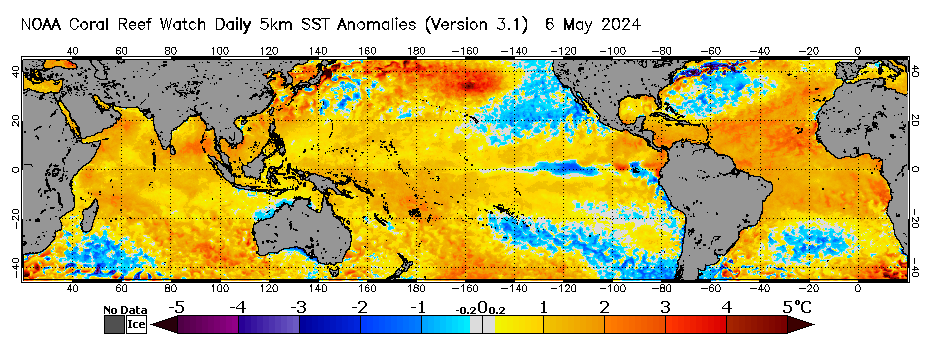 |
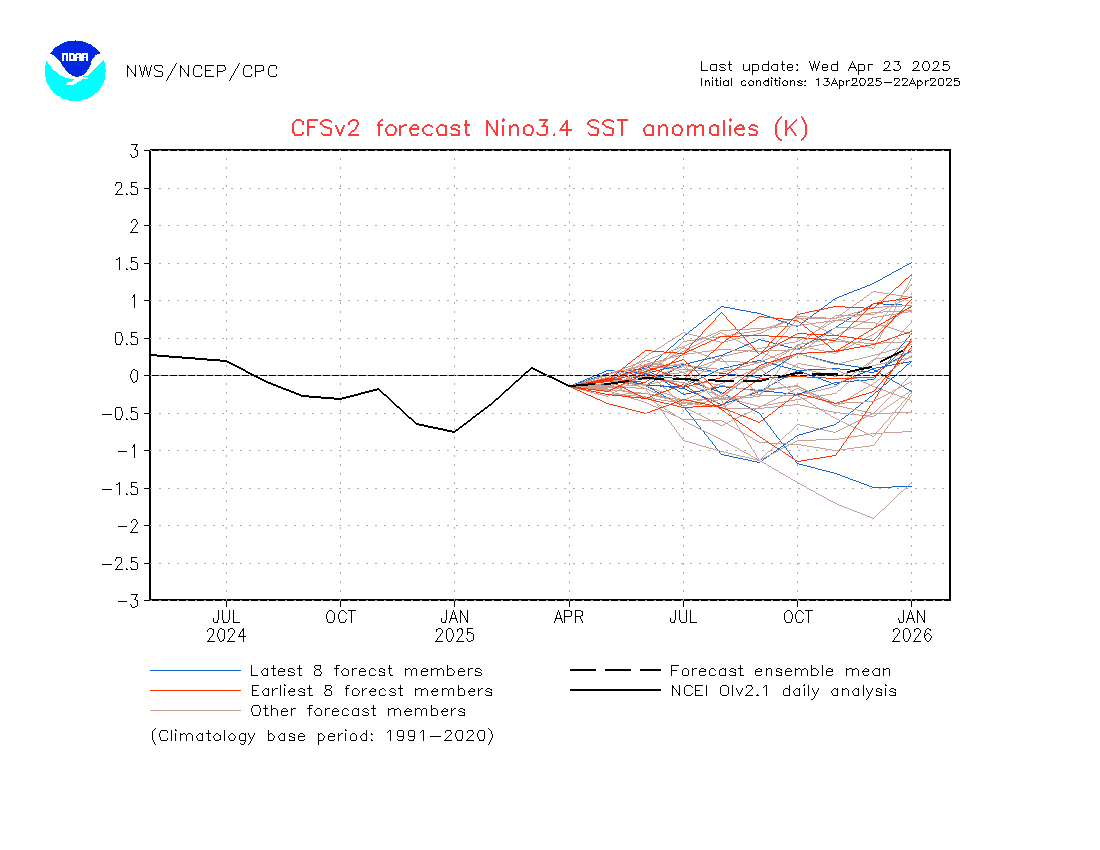
CFSV2 Forecast for Nino3.4 Sea Surface Temp (SST) Anomalies & Current SST Anomalies SST Anomaly Projections
CFSv2 Data (Nino3.4 Region)
Previous - Temps rose unexpectedly to +0.025 in March then faded only to -0.1 in April (far less that the -0.40 forecast) then steady at 0.00 in May-June. Temps started falling in mid-July down to -0.3 in Aug, -0.45 Sept and -0.40 in Oct.
Forecast (12/23) - Sea Surface Temp Anomalies for Nov did NOT fall nearly as hard as previously forecast (forecast was -0.95 but actual was -0.7) and then did not fall in Dec (forecast at -7.0 actual was -0.6). Temps are forecast rising from here forward -0.65 Jan, then neutral (0.0) in late Mar 2026 and building after that. The PDF Corrected forecast effectively suggests the same. It looks like we're in a weak Modoki La Nina for the Fall of '25 at worst, then turning neutral before reaching Winter proper.
IRI Consensus Plume: The Dec 19, 2025 Plume (all models) depicts temps are at -0.547, up from -0.649 in Nov. Temps to rise to -0.364 in JFM and 0.055 in AMJ. The Dynamic model suggest temps rising to -0.244 JFM and +0.643 at the end of the model run. The Statistic model suggests temps rising to +0.251 up from -0.538 at the end of the model run. In other words, We are just barely at weak La Nina today but back to neutral in January and forecast rising slowly from there indicating ENSO Neutral this Fall and Winter.
See chart here - link.
Atmospheric Coupling (Indicating the presence of El Nino in the atmosphere driven by the ocean):
Southern Oscillation Index (SOI) (negative is good, positive bad - all but the Daily Index was a lagging indicator):
Today (12/23) the Daily Index was steady at 12.61 but had been negative since 11/28-12/19, neutral at -1.40 a month ago.
The 30 day average was falling some at -2.17 peaking at 17.97 on 11/23, and had been rising steadily from +17.10 a month ago.
The 90 day average was rising at +7.72 and in weak La Nina territory peaking at +9.38 a month ago.
Pacific Decadal Oscillation (Negative is bad, Positive is good)
Past Recent History: The PDO theoretically turned from a warm (positive) trend in Spring of '98 and has cool (negative) mostly since then other than turning weakly positive March 2014-June 2017. It went hard negative in 10/2021-10/2023 driven by a 3 year La Nina conditions (down to -3.13). It started rising (but still negative) 11/2023-2/2024 driven by a strong El Nino, but not enough to even get it to break positive ground (best reading at -1.33 on 2/24). It then started falling in March 2024 down to -3.54 Sept (the lowest since April 1859) and -3.81 (Oct) the lowest ever reported. But in Nov the index final rose some to -3.24 and -2.08 in Dec 2024 and -1.32 in Jan 2025.
Current Situation: The index was steady at -1.67 Nov, -2.40 Oct, -2.38 Sept (and inline with average readings since Nov 2021), -3.18 Aug after falling hard in July at -4.0 (the lowest ever), -2.51 June, -1.71 May, -1.18 April, -1.12 March and -1.45 Feb 2025. Looking at the long term record, it seems likely we are stable and still in the Cool Phase of the PDO (La Nina 'like') since 5/1998 with no sign of moving to the positive/warm phase (El Nino 'like') of any meaningful duration yet. We need at least 3 months of -1.2 or higher values before one could guess that maybe the cool phase is weakening.
See imagery in the ENSO Powertool
Local Interest
Stormsurf Video Surf Forecast for this week. See it Here
For automatic notification of forecast updates, subscribe to the Stormsurf001 YouTube channel - just click the 'Subscribe' button below the video. - - -
ESPN Sports Center 'Ride of a Lifetime' - The backstory of Alo Slebir's possible 100+ ft wave at Mevericks - https://www.youtube.com/watch?v=luQSYf5sKjQ
NBC News - Climate Change and Surfing: https://www.nbcnews.com/mach/science/climate-change-good-surfing-other-sports-not-so-much-ncna1017131
Mavericks & Stormsurf on HBO Sports with Bryant Gumbel https://www.youtube.com/watch?v=luQSYf5sKjQ Pieces Featuring Stormsurf:
http://www.bloomberg.com/video/how-to-predict-the-best-surfing-waves-EsNiR~0xR5yXGOlOq2MqfA.html
http://www.cbsnews.com/videos/surfs-up-for-mavericks-invitational-in-calif/ Time Zone Converter By popular demand we've built and easy to use time convert that transposes GMT time to whatever time zone you are located. It's ion left hand column on every page on the site near the link to the swell calculator. Surf Height-Swell Height Correlation Table |